


Standing in front of a giant banner hanging from a water gate and emblazoned with the words “protect the water,” hundreds of farmers and farmers’ rights activists yesterday protested at the source of an irrigation channel in Changhua County’s Sijhou Township (溪州) over the Central Taiwan Science Park’s (CTSP) plans to divert water from the irrigation system.
“Water is already scarce and [the Changhua County Irrigation Association] only supplies water through irrigation channels four out of every 10 days,” Hsieh Pao-yuan (謝寶元), a farmer and president of the Alliance Against Water-Jacking by the CTSP, told the crowd. “With the CTSP planning to take more water from the irrigation channel, we Chang-hua farmers are going to be left with nothing — that is why we have to stand united and protect the water.”
Hsieh’s remarks drew a round of applause and cheers.
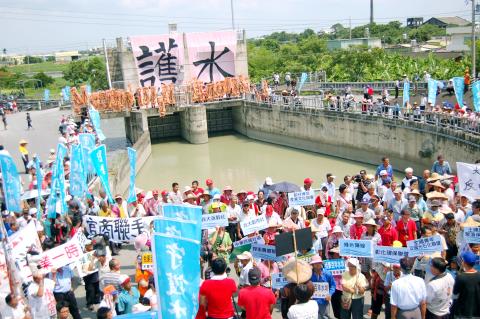
Photo: Liu Hsiao-hsin, Taipei Times
The farmers are worried because the association plans to build an underground aqueduct to supply more than 65,000 tonnes of water from the main Cizaipijun (莿仔埤圳) aqueduct to the latest campus in Erlin Township (二林).
The water in Cizaipijun comes from the Jhuoshui River (濁水溪) and is controlled by the water gate where yesterday’s rally was held.
Hsieh and other farmers are worried that the park’s diversion of the water could have a huge impact on farming families that depend on the irrigation channel to make a living.
“The Cizaipijun irrigation system supplies water to 180,000 hectares of farmland in southern Changhua County, including Sijhou, Erlin, Jhutang [竹塘], Dacheng [大城] and Fangyuan [芳苑] townships, which feed more than 30,000 farming families or more than 100,000 people,” Hsieh said. “The park said it would hire tens of thousands of people locally, but do they plan to feed so many people?”
The participants then performed a rite of worship to the river god, praying for him to protect the water.
Farming activist Yang Ju-men (楊儒門) questioned the legality of the plan to divert water from farms to industrial uses.
“Article 18 of the Water Act [水利法] stipulates that the allocation of water should follow the following order: first, family use; second, agricultural use; third, hydroelectric power plant use; and only then industrial and transportation use,” Yang said. “So it’s illegal to divert water from farms to the science park, especially when there is already insufficient water for irrigation.”
Sijhou Mayor Huang Sheng-lu (黃盛祿) accused the Irrigation Association of not informing residents before contracting out the aqueduct project.
He said, although the project was contracted out in December, the association only contacted the township office four months ago to ask if it could provide a venue for a public hearing.
Pointing to earlier comments by President Ma Ying-jeou (馬英九) that “if you care about the agricultural sector, you should not harm the farmers,” Taiwan Rural Front spokeswoman Tsai Pei-hui (蔡培慧) said that the lack of water was the most serious issue for farmers.
“The problem is not how much 1kg of bananas sells for, the real problem is that the government is trying to rob farmers of their land and water,” Tsai said.

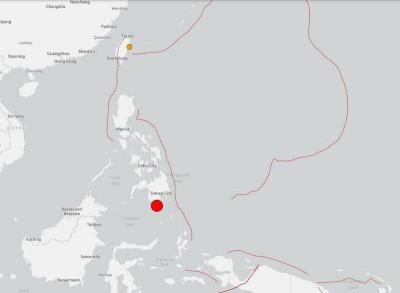
A magnitude 7.8 earthquake struck off the southern coast of Mindanao in the Philippines at 7:38am today, prompting the US Tsunami Warning System to issue an alert for neighboring countries, including Taiwan. The system issued a purple alert indicating a "tsunami threat." The potential threat zone includes Taiwan, the Philippines, Papua New Guinea, Yap and Palau. There were no immediate reports of major damage in the Philippines or Indonesia. The quake struck at a depth of 10km, said the German Research Centre for Geosciences, which had earlier pegged the earthquake at magnitude 8.2. Phivolcs, the Philippine agency, said the quake was magnitude 7 and

RESILIENCE: Taiwan plays a key role in semiconductors, energy, information infrastructure and advanced manufacturing, AIT Director Raymond Greene said Taiwan’s continued investment in deterrence and resilience remains vital, especially in uncrewed systems and other emerging technologies, American Institute in Taiwan (AIT) Director Raymond Greene said yesterday. Greene made the remarks at the annual National Strategic Summit on Supply Chain Resilience held by the Research Institute for Democracy, Society and Emerging Technology (DSET), a government-backed think tank. As Taiwan last year became the US’ fourth-largest trading partner and supply chain security is becoming more important, cooperation in emerging technologies continues to deepen between the two countries, he said. The US is committed to accelerating innovation, building key infrastructure, strengthening cooperation

The National Chungshan Institute of Science and Technology yesterday showcased its locally developed variants of the Vision 60 robotic patrol dog, which it plans to deploy on the nation’s outlying territories in the South China Sea. The variants were produced under the Joint Lab project — created by the institute and domestic companies — and assembled with domestically produced motors, lenses and artificial intelligence (AI) systems alongside licensed tech from the US, Missile and Rocket Systems Research Division deputy director Jen Kuo-kang (任國光) told the media event at a military base in Taipei’s Dazhi (大直) area. Taiwan has built up its strengths

RIGHT DIRECTION: Taiwan’s efforts to prevent forced labor include a proposal to ‘fully prohibit’ employers from withholding workers’ documents, an official said Taiwan is to establish a mechanism to restrict imports of goods linked to forced labor, the Executive Yuan said yesterday, after the US proposed imposing additional tariffs on Taiwanese goods over labor concerns. “The Ministry of Labor and the Ministry of Economic Affairs are to establish an interministerial review procedure,” Executive Yuan spokesperson Michelle Lee (李慧芝) said at a news briefing in Taipei. “The government is to use the Foreign Trade Act [貿易法] as the legal basis to restrict imports of goods produced with forced labor” and bring its supply chain governance more in line with international standards on human rights, resilience


 RSS
RSS